Customer Portal and Agent App for a Vietnamese Life Insurer
A ten-person Nexora team built a self-service customer portal, a field agent app and the shared platform behind them, including a Vietnamese speech pipeline running on real consultation audio.

Customer Portal and Agent App for a Vietnamese Life Insurer
Kết quả
The Challenge
A life insurer serves two groups whose needs pull in opposite directions. Customers use the system a few times a year to check a contract, understand their benefits, pay a premium or file a claim. There is no chance to train them, so every screen has to explain itself. Agents use it every day, need speed more than guidance, and work inside a multi-level downline where who can see whose data is a legal question, not a convenience. Both groups share one set of customer and contract data, so the two platforms could not be designed apart.
What Nexora Built
Nexora was the full development team, not extra headcount added to an existing one. Responsibility ran from design to operation, which matters for a system of this kind. The work covered three parts, all of them handed over to the client.
- Customer portal: contract and benefit lookup, premium payment, claim requests and personal information management
- Agent mobile app: customers and contracts by downline, sales activity, consultation call recording and downline reports
- Shared platform: identity and sessions, hierarchy-based authorization, audit log and integration with the insurer’s core system

Architecture
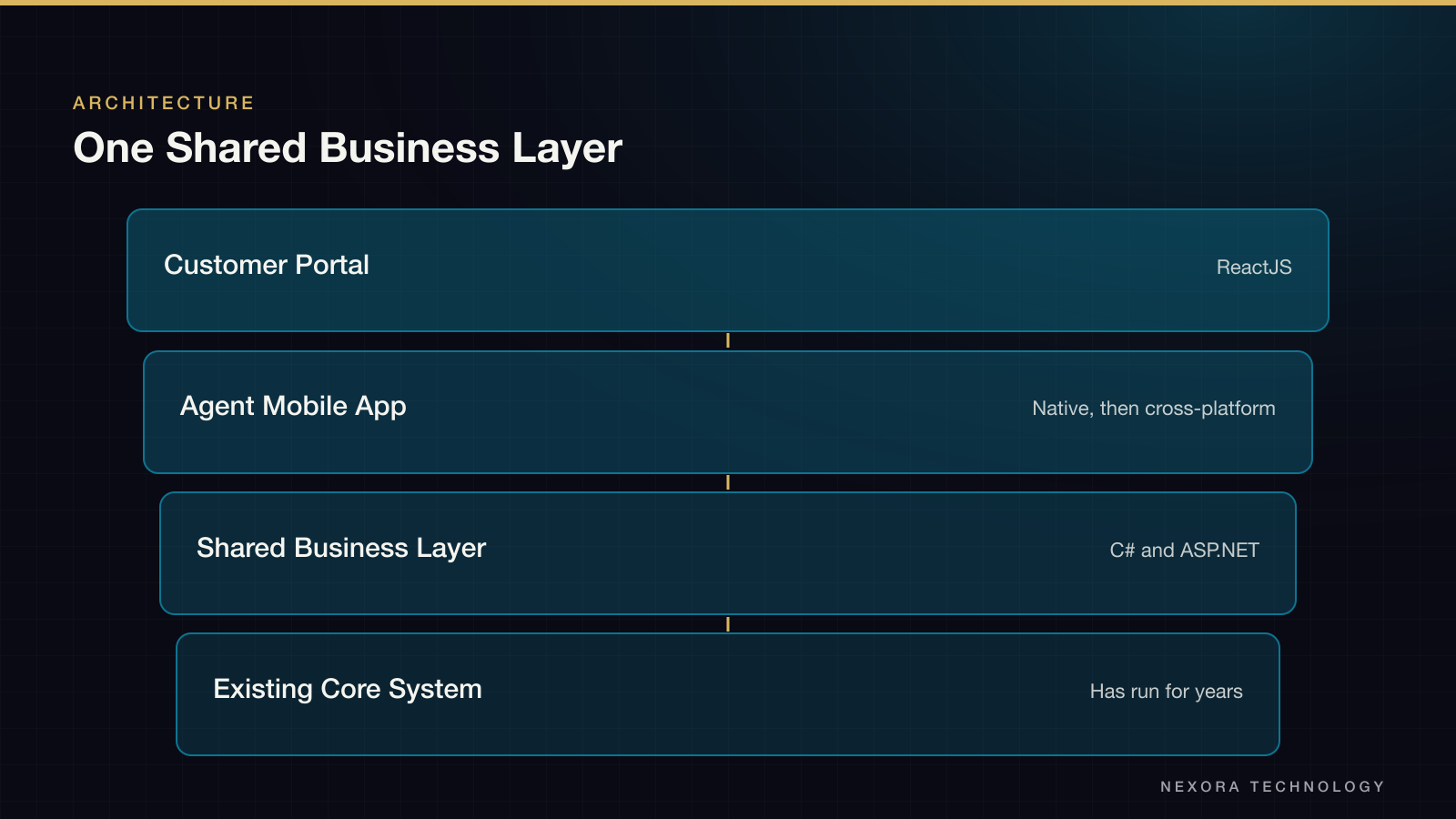
Both channels sit on one shared business layer written in C# and ASP.NET, which in turn integrates with a core system that has run for years. Nexora engineers chose a single layer over two systems synchronizing with each other. Customer and contract data are one dataset, and two-way sync between systems writing to the same data produces conflicts with no clean answer. The hardest design constraint was agent-line authorization. Lines change constantly as agents move, split and merge, and access has to change with them. An access record from last year must still read correctly against the line structure of that day, so the permission model needed a time dimension as well as a hierarchy.
The Speech Pipeline
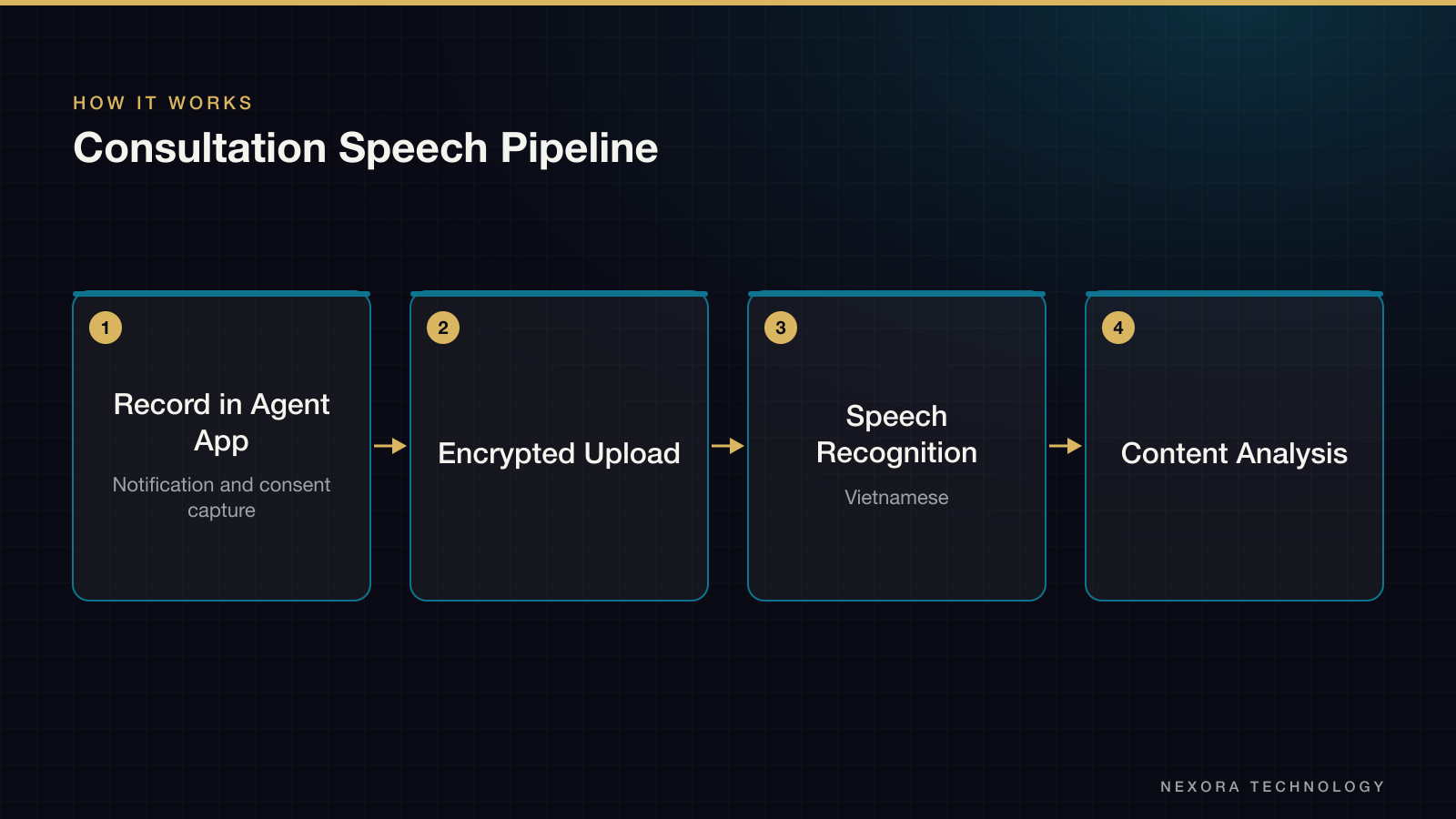
The most technically demanding part is a chain from consultation recording to Vietnamese speech recognition to content analysis. Recording happens inside the agent app with a notification flow, customer consent capture and encrypted upload, and each recording is tied to the right customer record. Insurance calls are hard for speech models in three ways at once: low audio quality from phone lines and field conditions, wide regional accents and a dense vocabulary of terms like refund value and exclusion clause plus product names no general dictionary holds. An uncalibrated model transcribes the greeting well and fails on the sentences that carry information. The lesson was to evaluate on business keywords instead of overall word error rate, which can look healthy while the terms that matter are wrong. The chain runs on real data in real operating conditions, and content analysis supports quality control.
Native First, Then Cross-Platform
The mobile app went through two phases. It started native, because call recording, audio stream handling and call state in the background are exactly where cross-platform abstraction layers cause the most trouble. Once those device-level pieces were solved and stable, the team moved to cross-platform, since the remaining changes were business logic that is identical on both operating systems. Moving earlier would have carried the hardest part into an environment that is harder to debug. Moving later would have meant paying for two parallel codebases for no gain.
Results
The platform was delivered and handed over after two continuous years with the same ten-person team. A system with both a customer portal and an agent app does not finish in one short release. It goes into operation, gets feedback from real users, is fixed where real load exposes problems and then expands, and that cycle only works if the team stays. Operating figures such as user counts and transaction volumes belong to the client and are not published here.
Tech Stack and Why .NET
The stack is C# and ASP.NET on the server, ReactJS for the portal and management dashboards, and mobile moving from native to cross-platform. .NET fits this class of system: long lifecycle, strict audit requirements and integration with core platforms that have run for many years. In those conditions long-term stability and the ability to find the next maintainer matter more than startup speed.
Bạn có một dự án tương tự?
Kể cho chúng tôi nghe. Cuộc tư vấn đầu tiên miễn phí.