A Website Support Model Built on Severity Levels and Reports
Nexora’s RFP response sets out a full website support and maintenance model: four severity levels with response targets, staged releases, patching rules, accessibility checks and monthly reporting.

A Website Support Model Built on Severity Levels and Reports
Results
Hours, Channels and Escalation
Support runs on weekdays, with four hours each day staffed in overlap with the client’s working hours. The client gets one shared ticket queue it can read, a shared chat channel for everyday questions and a phone number for critical issues. Non-technical colleagues never have to pick a severity, because they describe what they see and Nexora classifies it. Escalation goes from the engineer on duty to the technical lead to the project manager, who is reachable directly.
Severity Levels and Response Targets
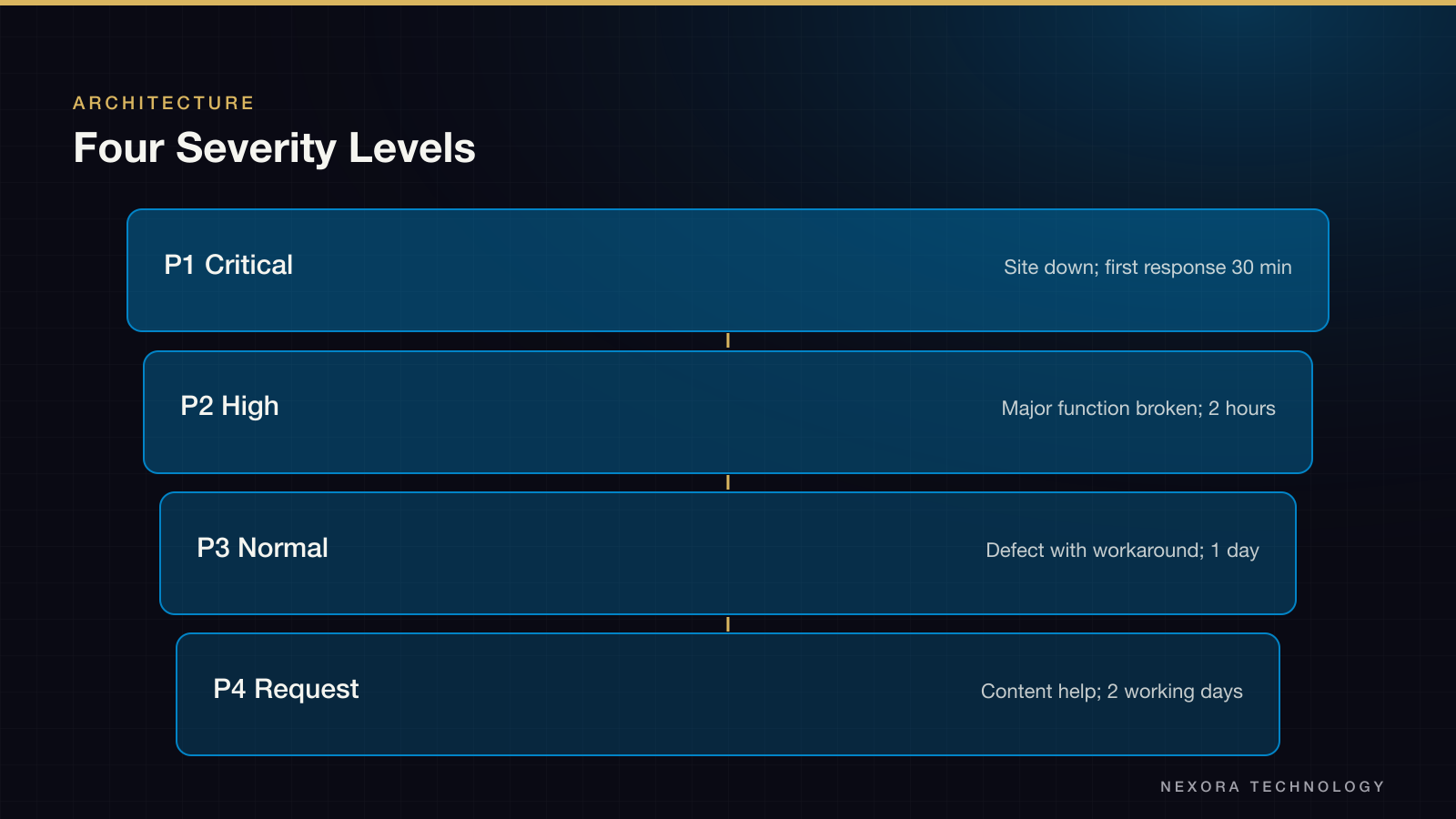
Four levels cover the range from a site outage to a content question. Every critical incident gets a written account within three working days that says what happened, why and what changed, including when the cause was Nexora’s. Automated uptime checks alert an on-call phone, so most critical issues are raised by Nexora first.
- P1 Critical: site down, security incident or data loss. First response in 30 minutes, hourly updates
- P2 High: a major function is broken or an accessibility barrier blocks a task. 2 working hours
- P3 Normal: a defect with a workaround. 1 working day, fixed in the next release
- P4 Request: content help or a small change. 2 working days
Reporting and Cadence
A fortnightly 30-minute check-in sets priorities. A monthly report follows by the fifth working day, covering hours used by category, tickets with response times against the targets, releases shipped, framework versions against their support dates, uptime and the last backup restore test. It also lists accessibility issues opened and closed, who holds which access and what Nexora recommends next.
Onboarding, Patching and Releases
Onboarding starts by shadowing the outgoing vendor, then delivers a state-of-the-site report: versions against support dates, cloud resources and who can reach them, a restored backup, monitoring coverage, an accessibility baseline, a risk register and a runbook. Dependency scanning runs weekly. Critical security releases reach staging the same day. Every change is approved on staging, released at an agreed time after a fresh backup, and checked by reading the result back in each language.
Security, AI Use and Accessibility
Access uses named accounts with multi-factor authentication and is reviewed quarterly. The proposal discloses that Nexora uses an AI coding assistant, then sets technical limits: a named engineer owns every change, nothing writes to production without a person, and the assistant never sees credentials or unpublished content. The client can opt out of AI assistance entirely. For accessibility, Nexora combines automated checks on every template, a manual keyboard and screen-reader pass, and a quarterly regression audit.
Ownership and Handover
The client owns all code, content, configuration and documentation, and works in its own repository and cloud project. Domains and hosting stay in the client’s name. Nexora keeps a handover pack current and offers thirty days of handover support if the client moves to another partner.
Got a similar project?
Tell us about it. First consultation is free.