Turning an Undocumented PowerBuilder ERP Into a Sizable Project
Nexora prepared a structured discovery questionnaire for modernizing an undocumented PowerBuilder ERP, so scope rests on source-code facts rather than guesses.
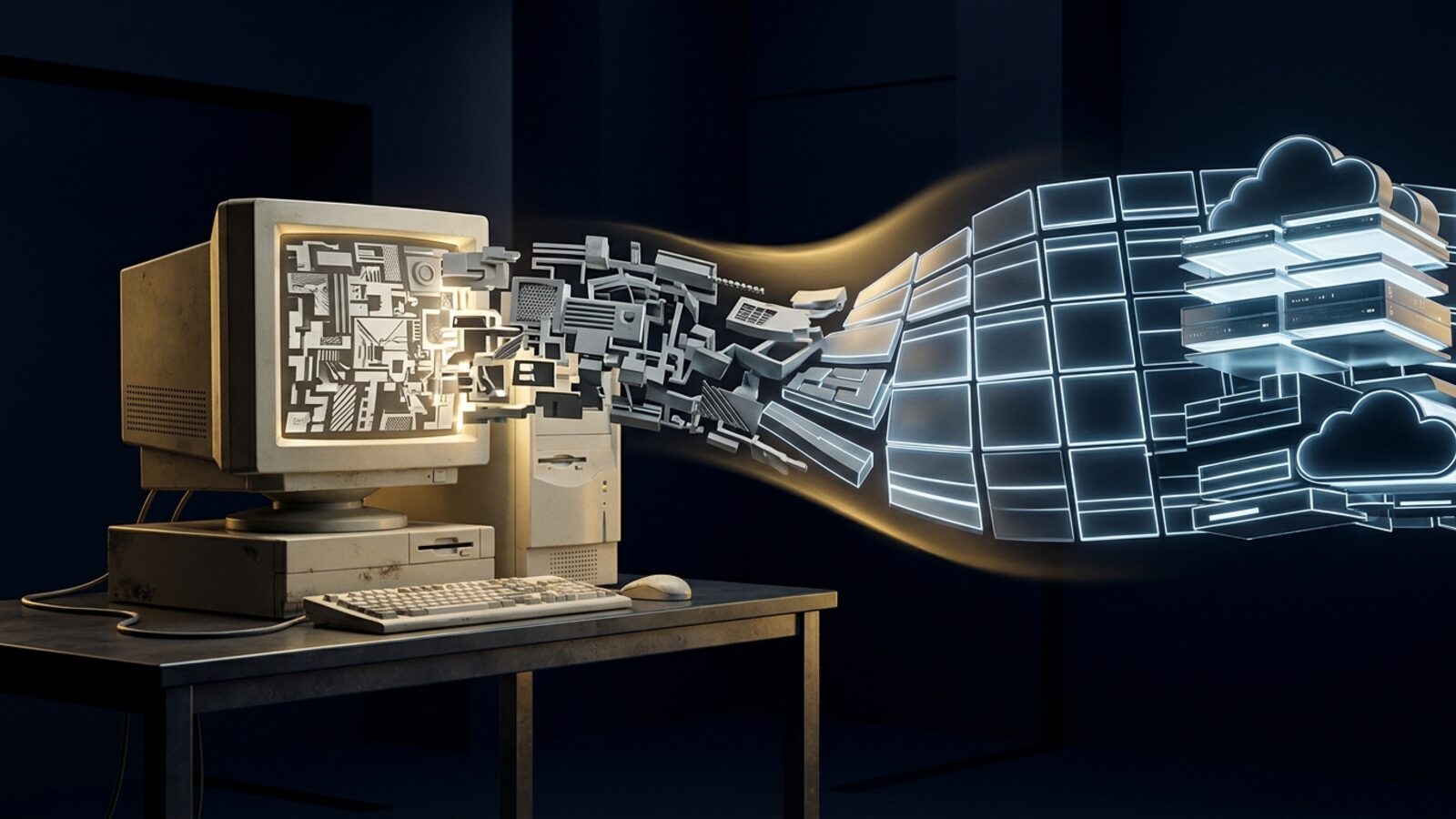
Turning an Undocumented PowerBuilder ERP Into a Sizable Project
Results
The Challenge
The system has no documentation, so its source code is the only specification. Sizing a rewrite from a screen count is the usual mistake. One DataWindow bundles a query, a grid, an entry form, validation and report formatting, and it expands considerably when rewritten on a modern stack. The sheet is built so the answers drive the sizing, instead of intuition.

How the Sheet Is Built
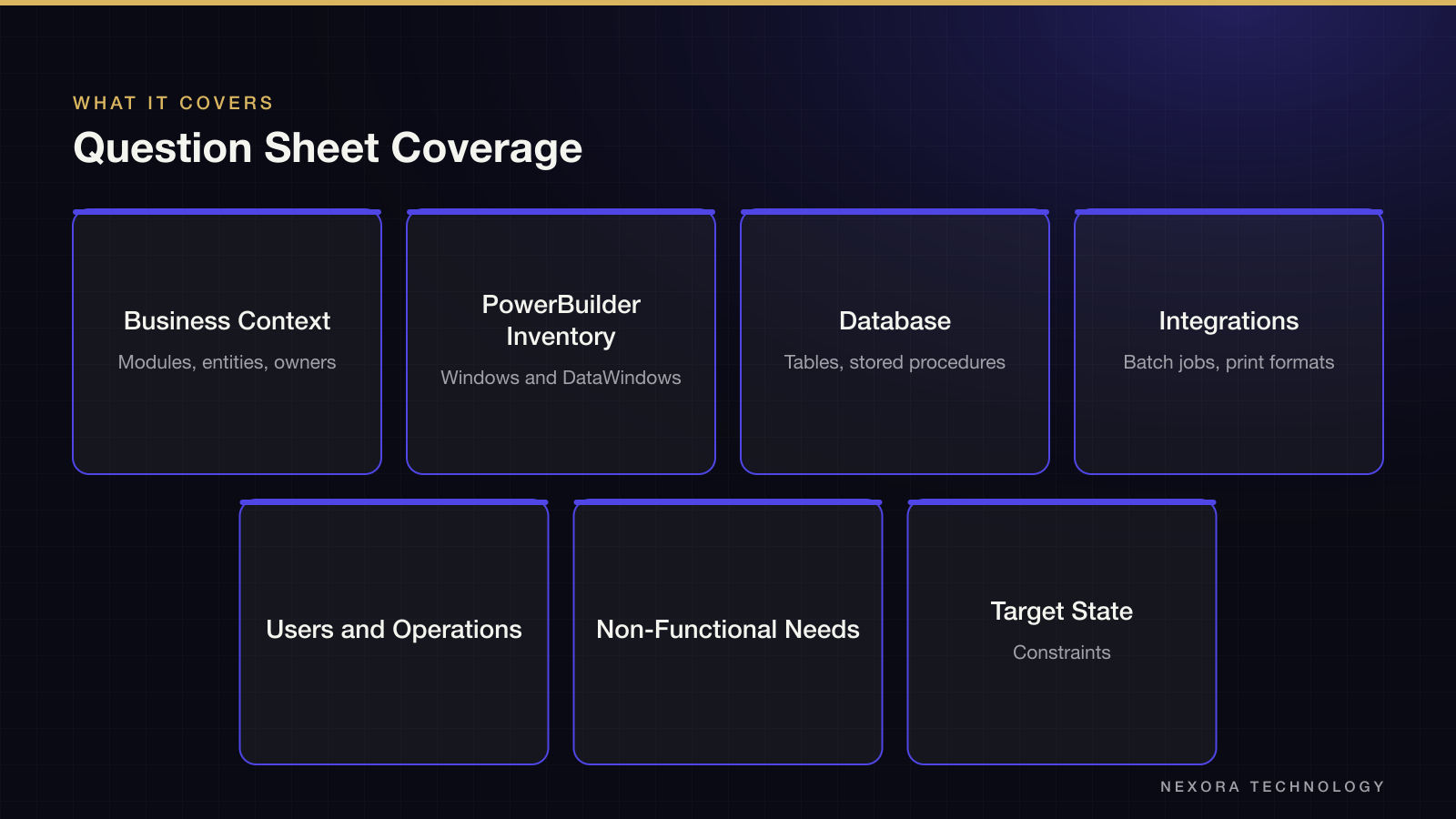
Seven groups cover the business context, the PowerBuilder inventory, the database, integrations, users and operations, non-functional needs, and target state and constraints. Every question lists why we ask and how the answer changes the scope, so the people answering know which ones deserve their time. Priorities run P0 to P2, and P0 means the question blocks sizing.
- Business context and scope: modules, entities, owners, prior attempts
- PowerBuilder inventory: libraries, windows, DataWindows, user objects, controls
- Database: engine, tables, stored procedures, shared access, test environments
- Integrations: external systems, batch jobs, print formats, hardware
- Users, non-functional needs, target state and constraints
Key Design Decisions
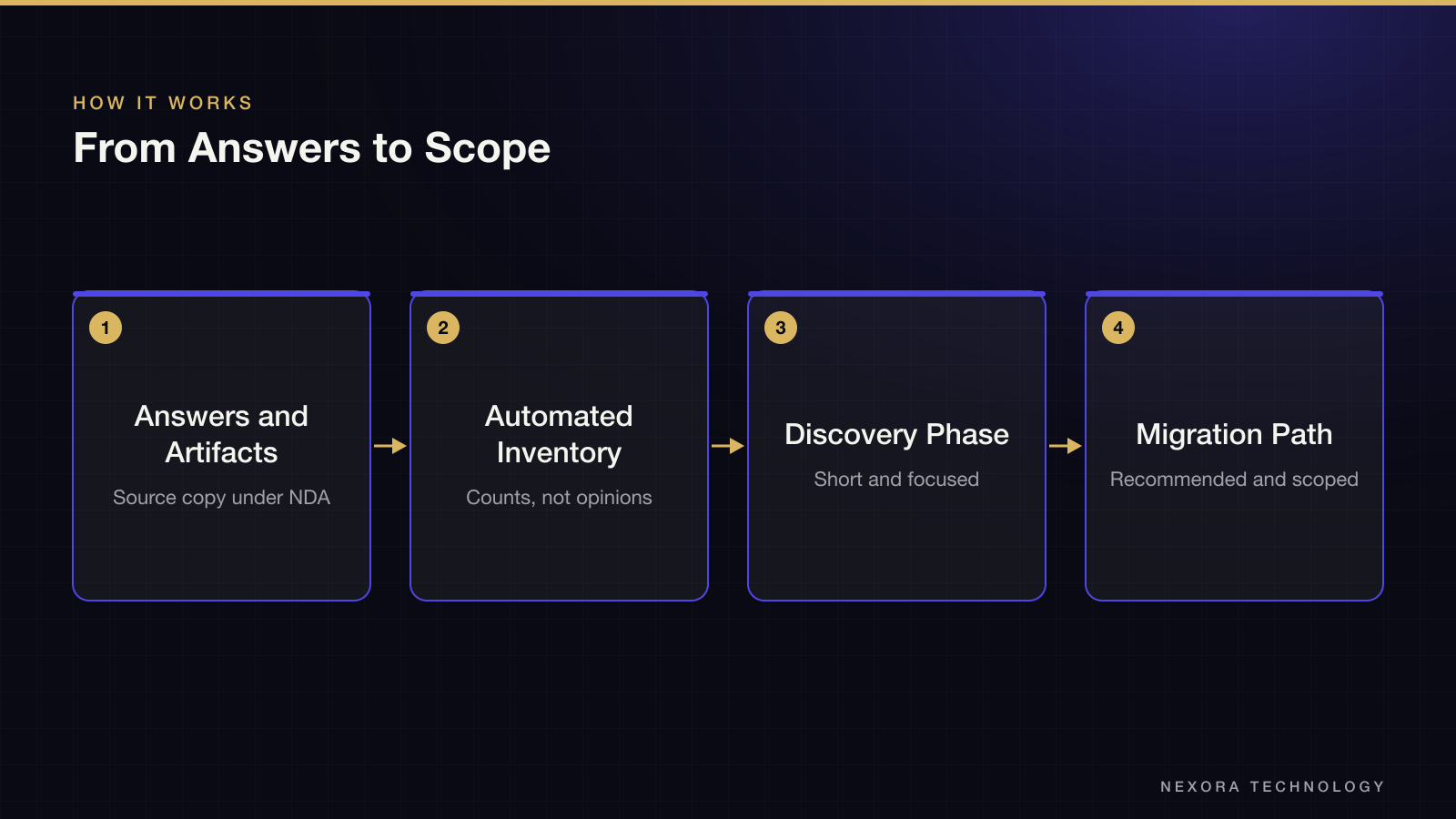
We ask for a read-only copy of the source under NDA so the inventory runs by script and returns counts, not opinions. We ask for the database schema, screenshots of key screens, printed document samples and a contact for each module. Unanswered items must be marked unknown, because a blank looks like not applicable. The sheet also forces the hard questions early: what modernize means, whether the cutover is big-bang or module by module, and who signs acceptance.
Where Logic Hides
Older PowerBuilder applications push a lot of business logic into the database, and validation often lives only in the client. Skip those layers and the new system runs wrong with nobody noticing. Shared databases, direct-DB integrations and legally fixed document layouts decide whether a gradual replacement is even possible. The sheet exists to surface these before any commitment is made.
What Happens Next
Once answers and artifacts return, Nexora runs the automated inventory and a short discovery phase. That produces the facts needed to recommend a migration path and to scope it. Information received is used only for pre-project assessment, under the NDA between the parties.
Got a similar project?
Tell us about it. First consultation is free.