

The Challenge
The platform does the whole job of a dropshipping seller. It finds source products from lists of product identifiers, publishes listings to several marketplaces, receives orders, buys the item again from the source and tracks delivery. That is a lot of moving parts, and it grew over years. Today it is a suite of C# microservices on AWS with about 165 repositories, five different .NET versions in use. Most of the engineering work is understanding what a service really does before changing it.
What Nexora Does
Nexora engineers work inside the client’s development team, take tickets from the client’s board and follow its review process. The work falls into five areas.
- Upgrading a legacy seller-listing service to .NET 5 and taking it to production
- Backend for a rebuilt seller portal: bulk listing import and payments
- Fixing integration bugs with one of the connected marketplaces
- Reviewing pull requests for the client’s own developers
- Recommending a common build pipeline for the .NET services

How the Platform Fits Together
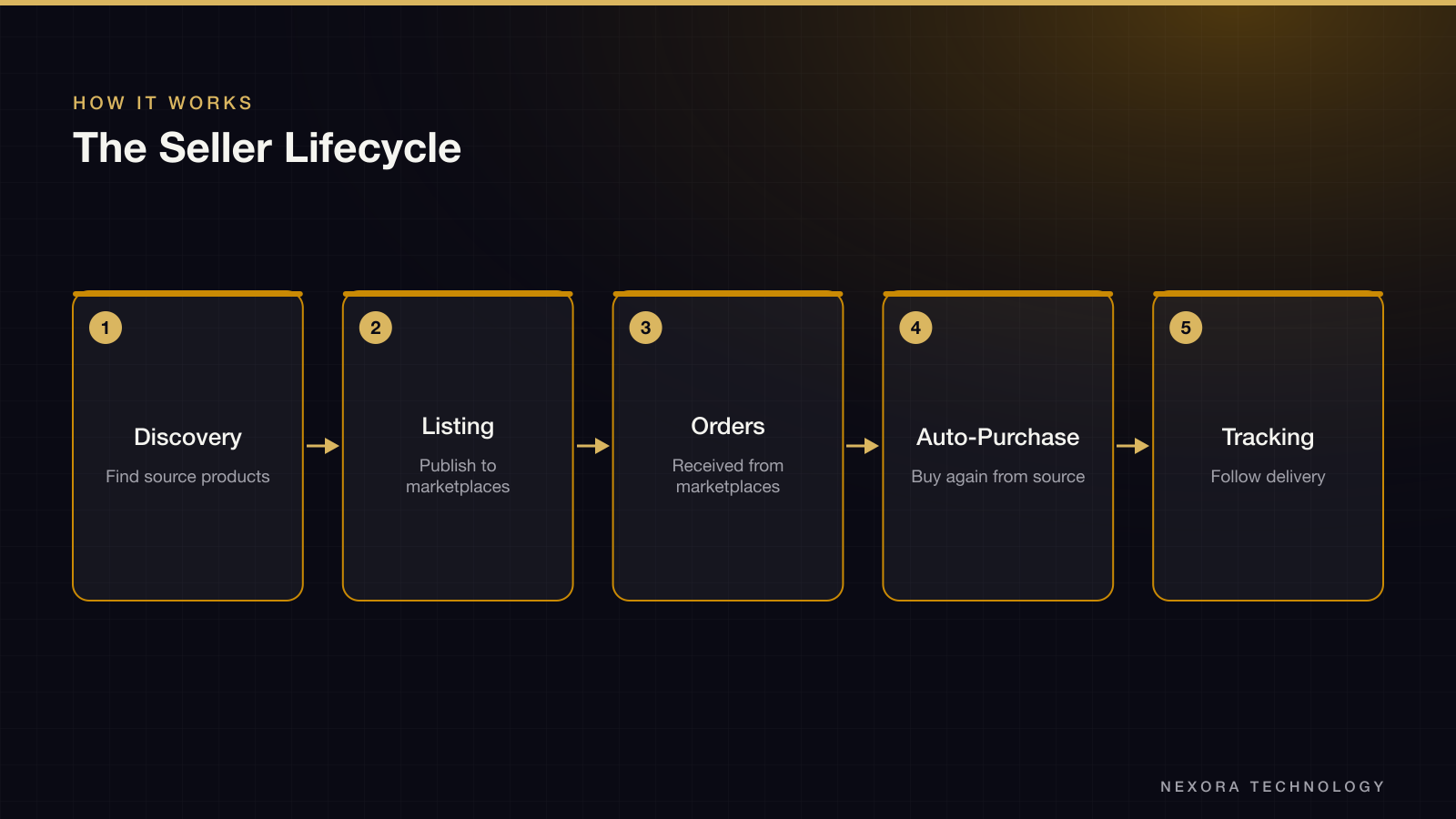
The business flow runs in five steps. Discovery finds products from the lists a seller imports or from automatic strategies. Listing publishes them to the destination marketplaces. Orders arrive from those marketplaces. Auto-purchase buys the item from the source. Tracking follows the shipment. Each step maps to one or more services, and some domains, discovery in particular, exist in several services owned by different client teams. Before touching code, an engineer has to identify which service is actually live for the flow in question.
Layered Services
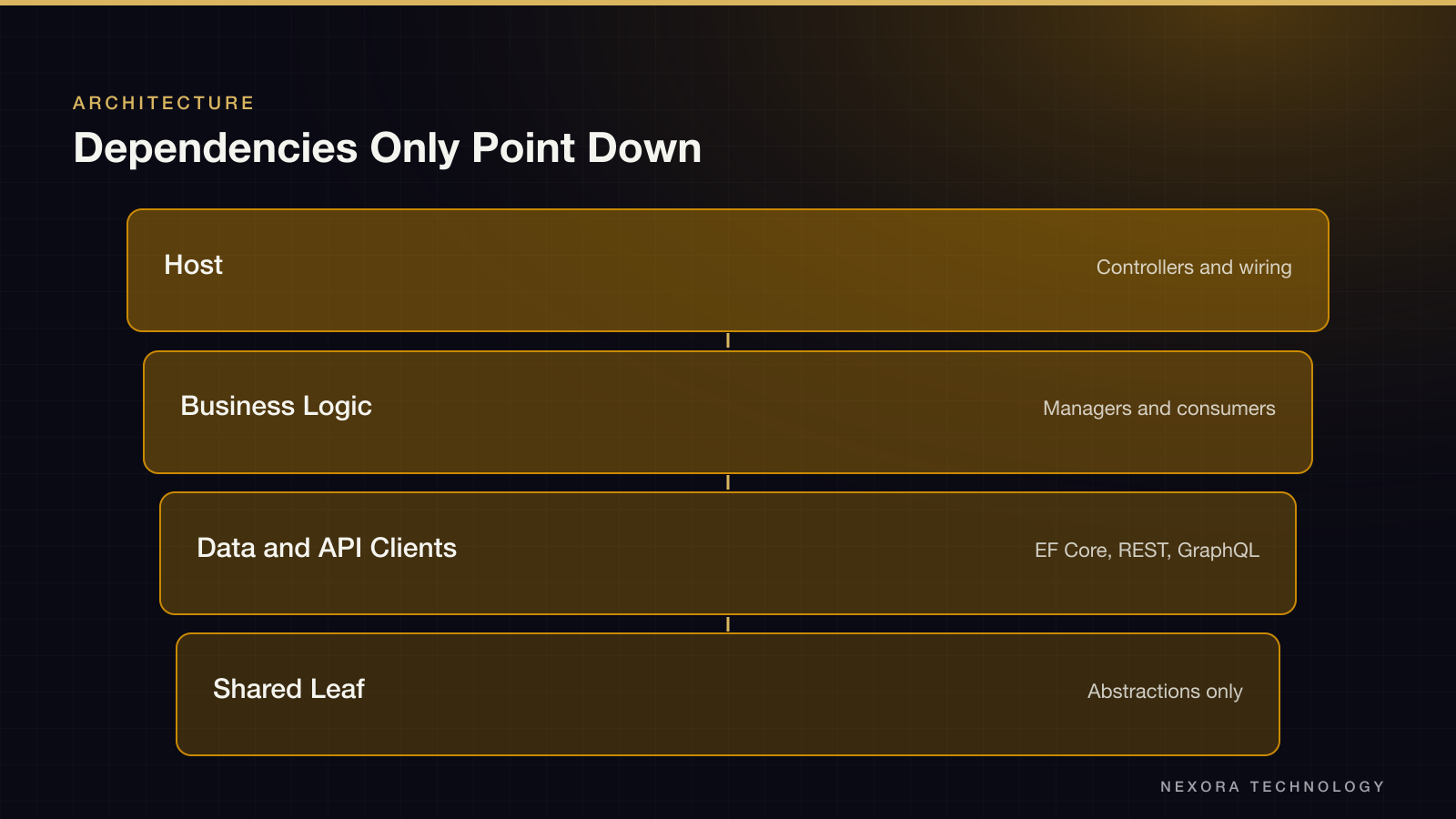
New and upgraded services follow one layering rule: the host depends on business logic, business logic depends on data access and outbound API clients, and everything bottoms out in a shared leaf with no dependencies. Nothing points back up. The rule keeps services testable, because every manager, data object and client sits behind an interface that can be mocked. Outbound HTTP calls get timeouts and retries when they are registered, and queue consumers declare their retry policy once instead of looping by hand.
The .NET 5 Upgrade
The seller-listing service is the one Nexora has worked on most, and its upgrade to .NET 5 was split into five sub-tasks. It went to the development environment on 15 July and to production on 22 July 2026. Six verification checks passed in both environments. The service uses SQL Server while most of the platform uses MySQL, so the team checked its queries against that provider rather than assuming the usual behavior.
Risks the Team Manages
A platform this size has traps that do not show up in a code review. Shared packages can pull in newer cloud SDK versions that break older frameworks unless a whole dependency group moves together, and local behavior does not always match production. Engineers write each trap down in an onboarding guide so the next person finds it in minutes, not days.
Results
The upgraded listing service is running on production. Backend work for the seller portal is complete and waiting for its front end, and the client’s developers have Nexora reviews on admin-dashboard changes that reached production. The platform’s volume, seller counts and revenue stay with the client.
Tech Stack
Backend services are C# on .NET, with Entity Framework Core and MassTransit over AWS SQS. They run on AWS ECS with MySQL on RDS, secrets in Parameter Store and logs in CloudWatch. Source and pipelines sit on Azure DevOps. The front ends are React with MobX and Ant Design, in both older and newer generations. The practical task is moving this mix forward one service at a time without stopping sellers.